 By
By The State of AI in Consulting is Spaik's annual research on how artificial intelligence is changing the consulting industry: its competitors, its operating model, its economics, its tools, and its obligations. The 2026 edition draws on public disclosures, executive statements, regulatory texts and documented incidents from mid-2025 to mid-2026, and adds Spaik's own reading of what they mean for firms. The full text of the findings is published on this page; the PDF adds the charts and full source list.
Key findings: what changed in 2026
Six developments define the year. Each is developed in its own chapter below and can be read on its own.
- 01
New entrants
Strategy firms now face competition on three fronts at once: AI research labs, tech scale-ups such as Palantir, and lean AI-native startups. In several cases their own AI suppliers and partners are becoming rivals.
- 02
Firm structure and the junior tier
AI is hitting hardest at the bottom of the pyramid. Three competing shapes, the diamond, the obelisk and the hourglass, are emerging to replace it, each thinning the junior base and rewarding technical and governance skills.
- 03
Revenue, billing and pay
AI is taking a fast-growing share of firm revenue while pushing clients toward outcome-based fees, which weakens the billable-hours model.
- 04
From chatbots to agents
The major firms have made agents standard equipment. The early payoff is measurable time saved, and the test is shifting from how many agents exist to how much value they create, with humans still accountable.
- 05
Trust and verification
A firm's authority is what turns an AI hallucination into a public error that others cite. Verifying AI output for fabricated sources before publication is becoming essential to protect the trust firms sell.
- 06
EU AI Act
Two sets of obligations are already in force and carry most of a consultancy's exposure. The biggest risks are weak AI literacy, accidentally adopting a banned tool, and unknowingly becoming the provider of a high-risk system. The UK has no AI-specific rule yet.
1. Established consultancies face competition from AI labs, tech scale-ups and AI-native firms
Traditional consulting is under pressure from AI, and the industry is reshaping around it. The big firms already earn part of their revenue from AI work and have built in-house units such as McKinsey's QuantumBlack and BCG X. They now face three kinds of new competitor: AI research labs, tech scale-ups, and AI-native advisory firms.
AI research labs are launching their own consulting arms
OpenAI, Anthropic and Mistral have started selling clients the same AI capabilities strategy firms offer. In May 2026, OpenAI launched the OpenAI Deployment Company, which helps mostly multinational clients deploy AI for operations and places engineers inside their organisations. McKinsey and Bain & Company are among its partners, an arrangement the investor Chamath Palihapitiya described as “letting the fox into the hen house.” It follows the Frontier Alliances deal that BCG and McKinsey joined to speed up enterprise rollout of agentic AI. Anthropic has launched its own services company to help mid-sized firms deploy Claude.
Asked by The Wall Street Journal whether AI labs threaten BCG, CEO Christoph Schweizer said demand for AI outstrips capacity and described the moves as complementary: BCG's job is redesigning workflows and reshaping whole companies, beyond increasing token consumption.[3]
Tech scale-ups are competing and partnering at the same time
Palantir formed partnerships with strategy firms such as Bain in March 2026, a route into the industry that parallels the labs' approach. Palantir's Forward Deployed Engineers threaten consulting firms directly: once an engineer has mapped a client's workflows and data, Palantir owns the relationship and has every reason to cut the consultant out.
AI-native consultancies are testing a leaner model
Queen's Tower Advisory runs an 80/20 model in which AI handles most analyst work, so the firm scales on agent capacity rather than headcount. Xavier AI builds AI consultants outright. Both aim to grow without hiring traditional consultants.
Accenture's share price fell a record 20% on 18 June 2026 after the company cut its full-year revenue growth guidance. Management attributed the cut to client pauses linked to geopolitical turbulence and stated that AI would not damage the business, while IT budgets are being redirected toward acquisitions in new growth areas.[7]
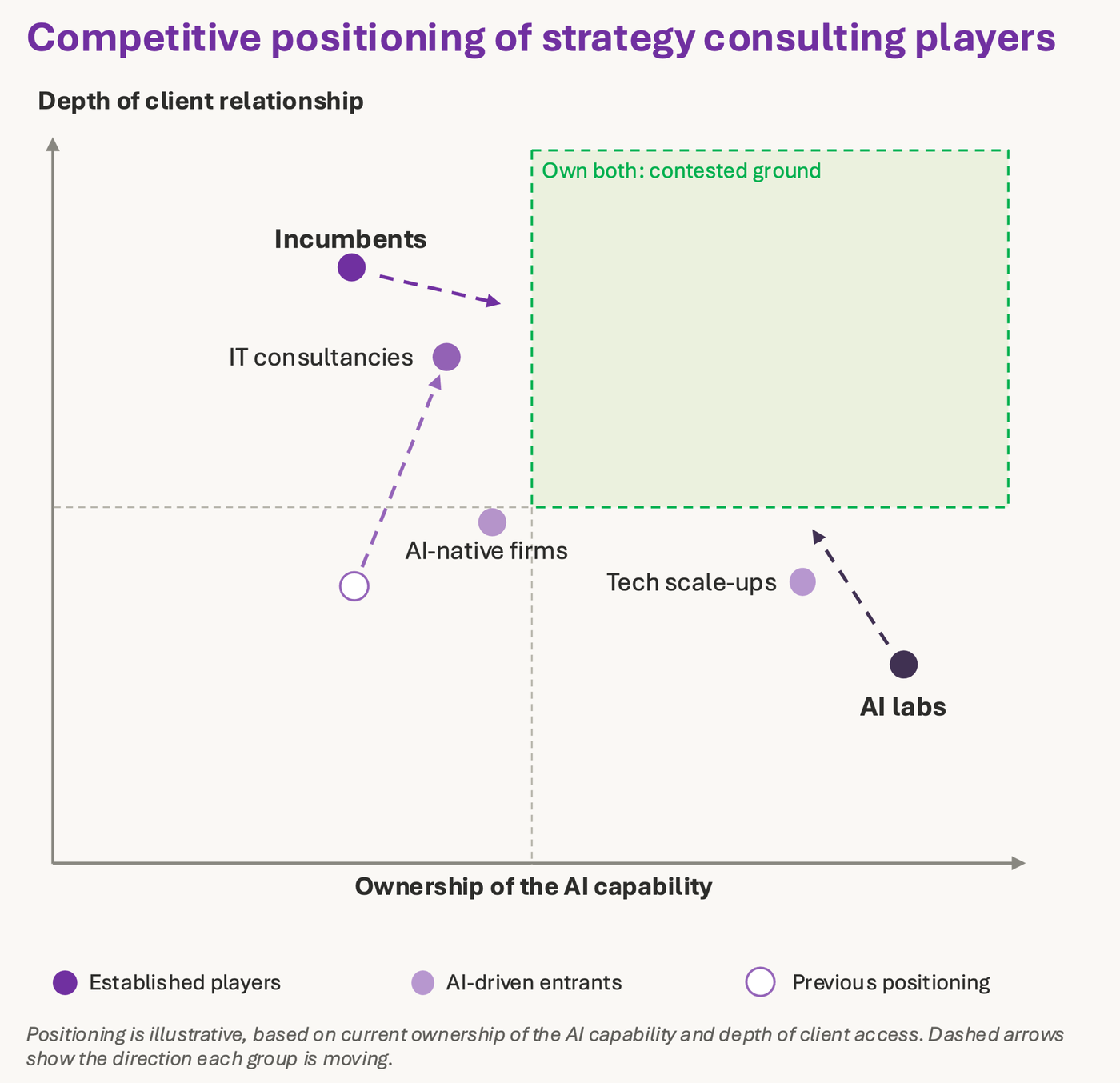
The chart describes a race toward the same square. Incumbents own the client relationship and are buying or building the AI capability; labs and scale-ups own the capability and are buying their way into the relationship, often through the incumbents themselves. The partner-of-today, competitor-of-tomorrow risk is the one to watch: a firm that resells a lab's deployment service is also training that lab on what clients pay for.
Read the full analysis: are AI labs becoming consulting firms?
2. AI pressure on the junior tier is replacing the consulting pyramid with leaner operating models
The consulting pyramid has begun to contract, partly because of AI. New entrants skip the traditional staffing structure: Queen's Tower Advisory and Unity Advisory run roughly 80% AI agents to 20% human consultants, and Xavier AI is building tools meant to replace consultants outright.
The junior tier is the most exposed
The work analysts have always done, research, data synthesis and slide-building, is exactly what AI does fastest and most reliably. Firms are also keeping entry-level salaries flat as revenue per employee rises.
PwC cut headcount by about 1.5% from 2024 to 2025 and dropped its goal of adding 100,000 employees by mid-2026, while training over 315,000 staff in AI. Global Chair Mohamed Kande has said the training is “boosting the productivity of our people.” In the UK, Chief People Officer Phillippa O'Connor tied the cuts to the UK market rather than AI, but acknowledged that “a graduate trainee does what a senior associate did three to five years ago.” UK graduate applications to PwC rose 35% for 2026, and the firm says it still needs junior staff to build the human skills AI cannot yet match.[6]
Three structures are emerging to replace the pyramid
| Structure | Shape | What changes | Key roles |
|---|---|---|---|
| Diamond | Thin junior base, wide middle and top | Fewer generalist analysts, more mid-career AI-fluent specialists such as AI engineers | Experienced specialists across the middle |
| Obelisk | Taller and leaner, fewer layers, smaller teams | Less reliance on junior staff; sharper thinking delivered faster with less overhead | AI facilitators (early-career, turn data into insight); engagement architects (frame problems, judge AI output); client leaders (advise senior executives) |
| Hourglass | Senior advisors on top, AI platform in the middle, governance base below | The platform does the production work; a governance layer validates outputs and keeps them auditable | Senior advisors, AI operators, governance and validation roles |
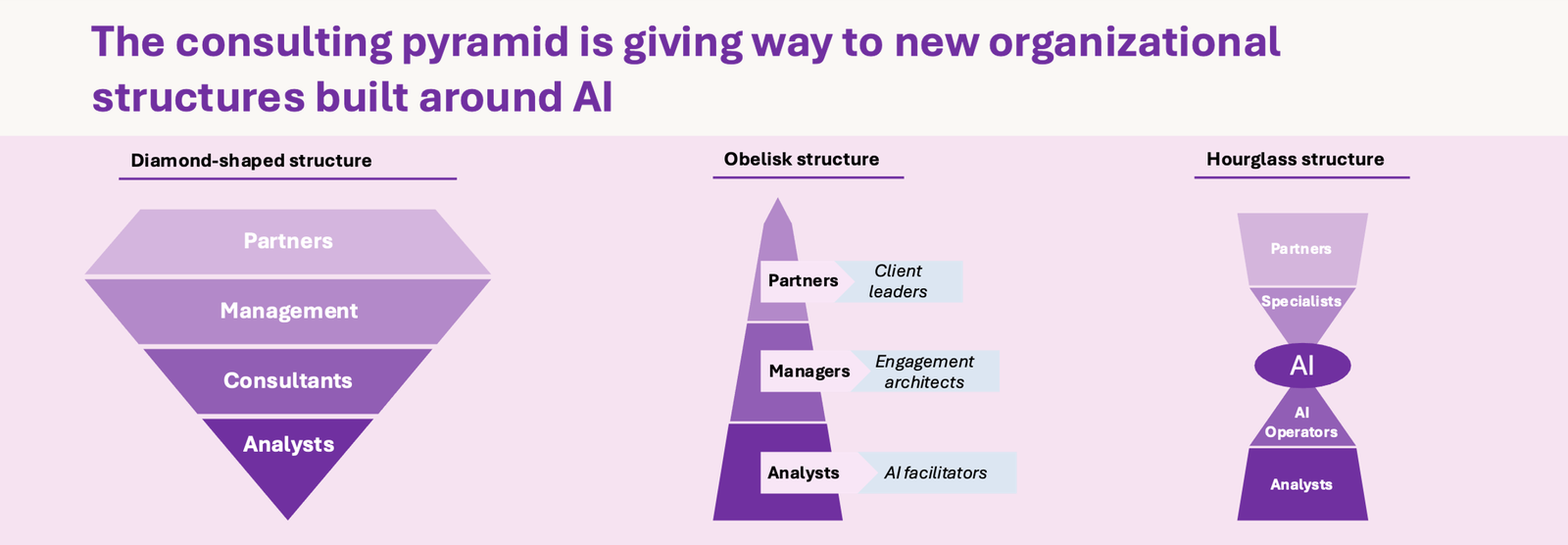
All three shapes make the same bet: the firm needs fewer people whose value is production and more people whose value is judgment, technical fluency and governance. That changes who gets hired, what a first-year learns, and which skills a training programme must build. The scarce skill is no longer producing the first draft; it is knowing whether the draft is right.
Read the full analysis: how AI is reshaping the consulting pyramid
3. AI is becoming a primary revenue stream, with higher demand for implementation
The latest figures from the major firms show AI taking a growing share of their projects and income, and a change in what clients buy: no longer advice alone, but systems built and running.
Gartner expects the AI services market to grow from $436 billion in 2025 to $759 billion in 2027, a compound annual growth rate of 31.9%.
BCG reported 2024 revenue of $13.5 billion with technology advisory (including AI) at 20% of the total; in 2025 revenue rose to $14.4 billion and AI- and technology-focused services now account for 40%. BCG X, which builds custom AI systems for clients, has more than 3,000 employees. Bain reports that technology- and AI-enabled work was about 30% of its business in 2025, with more than 2,500 AI projects delivered to date. McKinsey runs its AI work through QuantumBlack, which has more than 1,700 staff, and now reports a workforce of 60,000 that includes 25,000 AI agents.[4][5]
BCG CEO Christoph Schweizer describes the firm's role as redesigning entire workflows and upskilling organisations so that AI shows up in the P&L and in how people work, not just in token consumption, with a growing share of value-based projects.
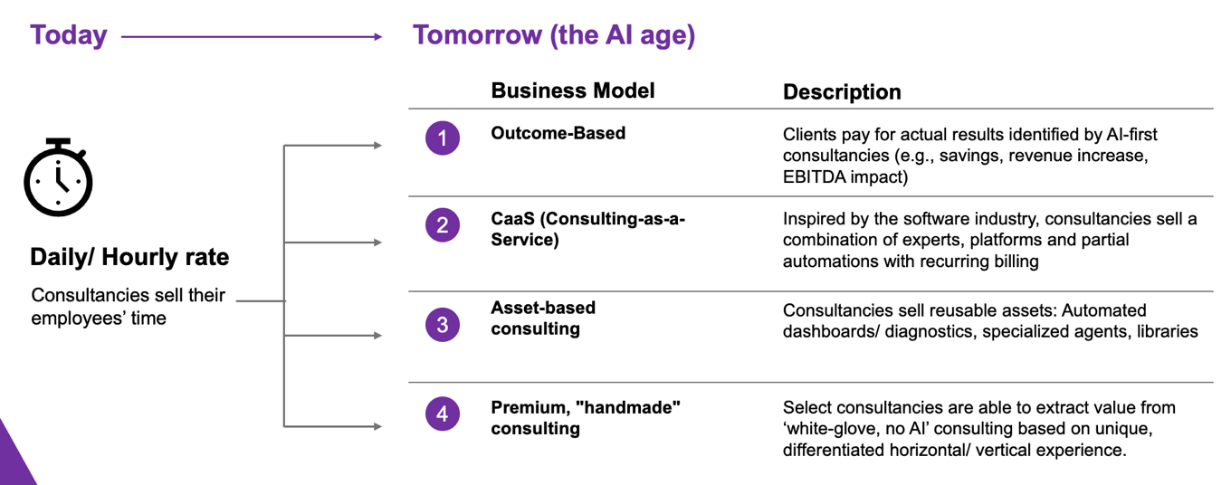
The billable hour was priced on scarcity of skilled time. When AI compresses that time, the same deliverable sells for less unless the firm changes what it charges for. The four models above are four answers to that question: charge for the outcome, for the recurring service, for the reusable asset, or for the genuinely handmade judgment. Most firms will end up running more than one.
Read the full analysis: how AI is changing consulting business models and pricing
4. Major consultancies staff agents alongside consultants
Strategy consulting has moved quickly from chatbots to agents. A chatbot answers prompts; an agent takes an objective, runs a workflow to reach it, and can call external tools along the way. The major firms now put agents in front of their consultants as standard equipment.
“I often get asked, ‘How big is McKinsey? How many people do you employ?’ I now update this almost every month, but my latest answer to you would be 60,000, but it's 40,000 humans and 20,000 agents.”[2]
McKinsey later revised the agent figure upward to 25,000, the number it calls most accurate, and wants every employee enabled by at least one agent within roughly 18 months. Its push started early: in August 2023 it rolled out Lilli, a generative-AI platform that searches and synthesises internal knowledge across more than 100,000 documents. BCG gives consultants Deckster for drafting slides and GENE, a conversational assistant, and after rolling out ChatGPT Enterprise firm-wide its consultants have built more than 18,000 custom GPTs. Bain chose to buy rather than build: Sage, developed with OpenAI, lets consultants generate insights from the firm's own intellectual property, alongside a customised ChatGPT and, more recently, Claude.
At BCG, consultants now spend about 15% less time on low-value work such as building slides and reinvest roughly 70% of those saved hours into higher-value work such as deeper analysis.[5]
The test is moving from how many agents exist to how much value they create. PwC's Chief AI Officer Dan Priest argues that people, not agents, still run the workforce, and that an agent is best measured by how well people use it rather than by how much it could automate in theory: “The human is still accountable. The humans are the ones who get certified. The humans are the ones who get licensed. The humans are the ones who get empowered.”[6]
Read the full analysis: AI agents in consulting
5. Hallucinated citations in published reports mark the first public AI failures in consulting
The speed that makes AI useful is also where the danger sits. Models hallucinate, and they do it confidently. In a knowledge business whose product is credibility, that has already produced cautionary failures. In June 2025 the UK's Financial Reporting Council warned the Big Four's audit teams that they lacked performance indicators for AI and pressed them to define how the tools affect audit quality.[8]
Deloitte (2025). A report published on the website of Australia's Department of Employment and Workplace Relations cited academic papers that did not exist and quoted a Federal Court judgment that was never made. Deloitte disclosed it had used Azure OpenAI in producing it and, in October, agreed to refund the final instalment of a roughly $290,000 contract.
EY (May 2026). EY withdrew a study on loyalty rewards programmes that its consultants had used to market the firm's cyber-security work in Canada after the research group GPTZero found more than half a dozen hallucinated footnotes, including a reference to a McKinsey report that does not exist.
KPMG (June 2026). KPMG removed “Redefining excellence in the age of agentic AI” (October 2025), which claimed UBS, NHS Greater Manchester, Swiss Federal Railways and Transport for London were running AI agents in ways those organisations said they were not. GPTZero identified the inaccuracies.
PwC Middle East (2026). GPTZero reviewed four reports. “Transforming Governance” (2025) claimed Denmark, Saudi Arabia, the US and Australia used a PwC framework called “Citizen Pulse”; no source supported it and the framework appeared nowhere else. Another report cited a URL still carrying a ChatGPT tag.[10][9]
A report with fake citations can “poison the well” for future researchers, “especially if the report is published by a well-known consulting firm and hosted on a high-traffic website.”[9]
The pattern is identical in each case. A firm whose authority makes people trust its work published claims that were never true, and that authority is exactly what turned a private mistake into a public one. Source verification should be a mandatory step in the delivery process: no AI-generated claim reaches a client or the public until a human has traced it to a real document. The EU is legislating in the same direction: Article 4 of the AI Act requires deployers to ensure adequate AI literacy among staff.
Read the full analysis: AI hallucinations in consulting
6. The EU AI Act's in-force obligations create concrete compliance exposure
The EU AI Act entered into force on 1 August 2024 and uses a risk-based framework.[1] Several obligations already apply, including AI literacy, prohibited practices, governance rules, penalties and transparency requirements. Three matter most for consultancies.
| Provision | What it requires | Exposure for a consultancy | Practical response |
|---|---|---|---|
| Article 4: AI literacy | Providers and deployers must ensure adequate AI literacy among staff and others using AI on their behalf | Weak literacy can aggravate other penalties and signals poor governance | Role-specific training, with a record of who was trained and on what |
| Article 5: prohibited practices | Bans specified uses such as workplace emotion recognition, social scoring and some biometric identification; penalties up to EUR 35 million or 7% of worldwide annual turnover | Mostly accidental: a team adopts a third-party tool without realising one feature is prohibited | Screen AI tools before adoption; list banned uses explicitly in the AI policy |
| Article 25: becoming a provider | Sets out when an organisation becomes the provider of a high-risk AI system, triggering additional duties | As firms scale AI offerings, new engagements can reclassify them as providers | Assess each AI engagement against the provider criteria before scoping it |
The UK has no single AI-specific law. Regulators apply five non-binding principles: safety, transparency, fairness, accountability and contestability. UK consultancies still face adjacent rules that affect how they use AI, including UK GDPR, consumer law, financial services regulation and the Online Safety Act, as well as the EU AI Act when they work with EU clients. An FCA executive director has urged UK authorities to keep pace with AI's growth and to consider bringing AI tools within financial services regulation.
This chapter is provided for informational purposes and does not constitute legal advice.
Read the full analysis: the EU AI Act for consulting firms
About this report and how to cite it
The State of AI in Consulting is published annually by Spaik, an AI advisory and capability-building firm working with consultancies, investment banks and private equity funds. The 2026 edition is a synthesis of publicly available material, company disclosures, executive interviews, regulatory texts and documented incidents, published between mid-2025 and mid-2026, combined with Spaik's analysis from its work with consulting teams. Third-party figures are attributed to their numbered source in the notes at the end of each chapter's analysis and of this report; Spaik did not produce those statistics. Where the text offers an interpretation, it is Spaik's own.
Suggested citation: Foucault, A. (2026). The State of AI in Consulting 2026. Spaik. https://www.spaik.co/en/state-of-ai-in-consulting
Figures 1 and 2 are Spaik charts and may be reused with attribution to Spaik and a link to this page. Figure 3 is reproduced from the HEC Paris Alumni Club white paper cited in its caption[11] and remains subject to its authors' terms.
Notes and sources
- Regulation (EU) 2024/1689 (the EU Artificial Intelligence Act), Official Journal of the European Union, Articles 4, 5 and 25
- HBR IdeaCast, interview with Bob Sternfels, Global Managing Partner of McKinsey & Company, January 2026
- The Wall Street Journal, interview with Christoph Schweizer, CEO of Boston Consulting Group
- Gartner, AI services market forecast (2025 to 2027)
- BCG, Bain & Company and McKinsey & Company public statements on revenue mix, AI units and agent deployment, 2024 to 2026
- PwC statements by Mohamed Kande (Global Chair), Phillippa O'Connor (UK Chief People Officer) and Dan Priest (Chief AI Officer), 2025 to 2026
- Accenture full-year guidance revision and market reaction, 18 June 2026
- UK Financial Reporting Council, communication to Big Four audit teams on AI performance indicators, June 2025
- GPTZero (Om Ogale, Paul Esau, Alex Cui), analyses of citations in EY, KPMG and PwC Middle East reports, 2026
- Australian Department of Employment and Workplace Relations, Deloitte report and partial refund, 2025
- ConseilIA: le nouvel âge du Conseil Augmenté, collective white paper, HEC Paris Alumni Club Consulting & Coaching, 2026
Figures attributed to third parties are their own reported data; Spaik did not produce those statistics. Where the text offers an interpretation, it is Spaik's own.
Go deeper
- Are AI labs becoming consulting firms?Chapter 1, expandedRead
- How AI is reshaping the consulting pyramidChapter 2, expandedRead
- How AI is changing consulting business models and pricingChapter 3, expandedRead
- AI agents in consulting: how McKinsey, BCG, Bain and others use themChapter 4, expandedRead
- AI hallucinations in consulting: why verification is becoming business-criticalChapter 5, expandedRead
- EU AI Act for consulting firms: what consultancies need to knowChapter 6, expandedRead
- Previous edition: The State of AI in Consulting 2025ArchiveRead
For consulting firms
Turning the findings into a plan for your firm
Spaik works with consultancies on the questions this report raises: where AI belongs in the engagement model, how to build verification and AI literacy into delivery, and how to train consultants to direct AI rather than compete with it.