
For most of its history, strategy consulting competed with strategy consulting. In 2026 the established firms face competition on three fronts at once: the AI research labs whose models they resell, the tech scale-ups whose platforms they implement, and a new class of AI-native advisory firms built without a pyramid. The 2026 edition of Spaik's State of AI in Consulting finds that in several cases the incumbents' own suppliers and partners are becoming their rivals. This article examines each front and what the landscape looks like when they are put together.
Key takeaways
- In May 2026 OpenAI launched the OpenAI Deployment Company, which helps mostly multinational clients deploy AI for operations and places engineers inside their organisations. McKinsey and Bain are among its partners. Anthropic has launched its own services company to help mid-sized firms deploy Claude.
- Palantir formed partnerships with strategy firms including Bain in March 2026. Its forward-deployed engineers map a client's workflows and data, after which Palantir owns the relationship and has every reason to cut the consultant out.
- AI-native consultancies such as Queen's Tower Advisory run an 80/20 model in which AI handles most analyst work; Xavier AI builds AI consultants outright. Both aim to grow without hiring traditional consultants.
- BCG's CEO calls the labs' moves complementary, arguing demand outstrips capacity and that BCG's job is redesigning workflows and reshaping companies. The competitive chart tells a more contested story: every group is moving toward owning both the client relationship and the AI capability.
Three new fronts at once
The big firms already earn part of their revenue from AI work and have built in-house units, McKinsey's QuantumBlack and BCG X among them. That AI revenue is exactly what the new entrants are targeting. The report groups them into three kinds: AI research labs launching their own consulting arms, tech scale-ups that both partner with and compete against consultancies, and AI-native firms trying to prove a leaner model is possible. Each attacks from a different position, and each is moving.
The labs: OpenAI, Anthropic and Mistral move into deployment
OpenAI, Anthropic and Mistral have started selling clients the same AI capabilities strategy firms offer. The most visible step came in May 2026, when OpenAI launched the OpenAI Deployment Company, which helps mostly multinational clients deploy AI for operations and places engineers inside their organisations. McKinsey and Bain & Company are among its partners. It follows the Frontier Alliances deal that BCG and McKinsey joined to speed up enterprise rollout of agentic AI.[1] Anthropic, for its part, has launched its own services company to help mid-sized firms deploy Claude.[2]
“Letting the fox into the hen house.”[3]
Asked by The Wall Street Journal whether AI labs threaten BCG, CEO Christoph Schweizer said demand for AI outstrips the capacity to meet it and described the labs' moves as complementary. BCG's job, in his account, is redesigning workflows and reshaping whole companies, beyond increasing token consumption.[4]
Both readings can be true at once. Today the labs need the incumbents' client access and change-management muscle, and the incumbents need the labs' models; the partnership is rational. But every deployment run jointly teaches the lab what clients actually pay for and puts its engineers in the room. The partner of 2026 is acquiring the one asset it lacked, and the incumbents are helping.
Tech scale-ups: Palantir and the forward-deployed engineer
Palantir formed partnerships with strategy firms such as Bain in March 2026, a route into the industry that parallels the labs' approach.[5] The competitive mechanism is the forward-deployed engineer. Once a Palantir engineer has mapped a client's workflows and data, Palantir owns the relationship and every reason to cut the consultant out. The consultant brought the introduction; the platform keeps the account.
AI-native consultancies: the 80/20 model
The third front is the AI-native consultancy. Queen's Tower Advisory runs an 80/20 model in which AI handles most of the analyst work, so the firm scales on agent capacity rather than headcount. Xavier AI builds AI consultants outright.[6] Neither is large. Their importance is as proof that a client deliverable no longer requires the junior base the incumbents were built on, a point developed in how AI is reshaping the consulting pyramid.
How the incumbents are responding
The established firms are not standing still. They have built delivery units (BCG X has more than 3,000 employees; QuantumBlack more than 1,700), moved a large share of revenue into AI and technology work, and joined the labs' alliances rather than fight them. The pressure is nonetheless visible at the edges of the industry.
Accenture's share price fell a record 20% on 18 June 2026 after the company cut its full-year revenue growth guidance. Management attributed the cut to client pauses linked to geopolitical turbulence and stated that AI would not damage the business, while IT budgets are being redirected toward acquisitions in new growth areas.[7]
Supplier, partner, competitor: the landscape in one chart
The report maps the players on two axes: depth of client relationship, and ownership of the AI capability. The top-right quadrant, owning both, is the contested ground every group is moving toward.
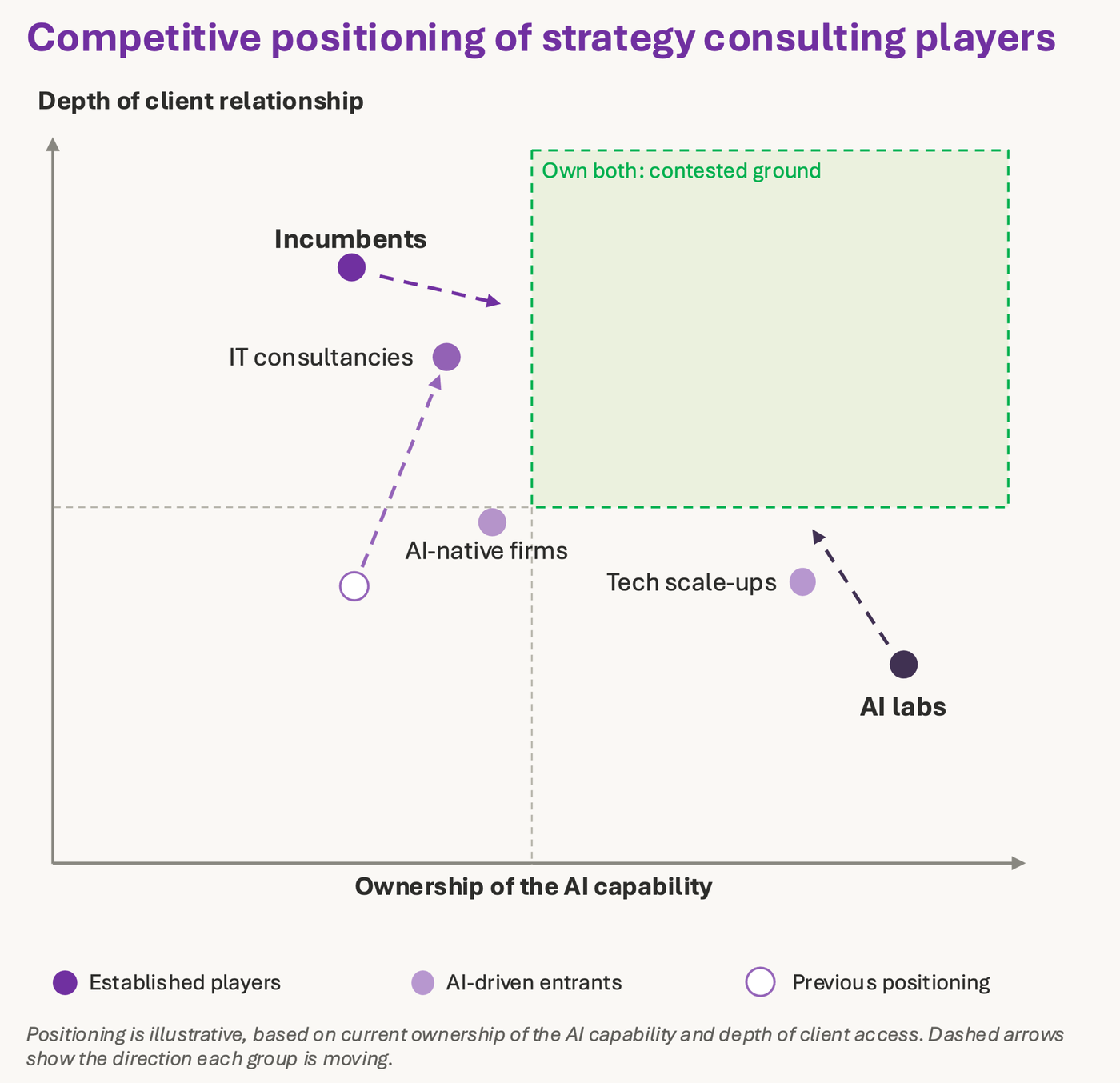
| Group | Starting position | Direction of travel | Relationship to incumbents today |
|---|---|---|---|
| Incumbents (strategy firms) | Deep client relationships, partial ownership of AI capability | Toward owning the capability: in-house units, alliances, custom systems | The reference point |
| IT consultancies | Deep relationships, stronger technical ownership | Toward higher-value advisory work | Competitor on implementation |
| AI labs (OpenAI, Anthropic, Mistral) | Own the capability, shallow client relationships | Toward the client, via deployment companies and alliances | Supplier and partner today; competitor in formation |
| Tech scale-ups (Palantir) | Own the capability, growing client access through forward-deployed engineers | Toward owning the account | Partner that can displace the consultant |
| AI-native consultancies | Lean, agent-first, limited client depth | Toward credibility with larger clients | Competitor on price and model |
What this means for established firms
The asset that is hardest to buy
A lab can hire engineers and fund a deployment company. A scale-up can place engineers inside a client. What neither can buy quickly is the incumbents' combination of trust, access and the ability to make an organisation change how it works. Schweizer's point about redesigning workflows is the right defence, but only if it is true in practice: an incumbent whose consultants cannot themselves use AI with judgment is reselling the lab's capability with a markup, and markups get competed away.
The strategic response the report's chart implies is to move right faster than the labs move up: own enough of the AI capability, in tooling and above all in people, that the client relationship rests on something the supplier cannot replicate. That is a capability-building problem before it is a partnership problem, and it is the reason AI fluency has become a commercial question for consulting firms rather than an HR one.
This analysis expands chapter 1[8] of The State of AI in Consulting 2026. For the revenue these groups are competing over, see how AI is changing consulting business models and pricing.
Notes and sources
- OpenAI, launch of the OpenAI Deployment Company (May 2026) and the Frontier Alliances programme; partner statements by McKinsey & Company and Bain & Company
- Anthropic, launch of a services company to help mid-sized firms deploy Claude
- Chamath Palihapitiya, public remarks on the OpenAI Deployment Company partnerships
- The Wall Street Journal, interview with Christoph Schweizer, CEO of Boston Consulting Group
- Palantir, partnerships with strategy firms including Bain & Company (March 2026)
- Queen's Tower Advisory and Xavier AI, public descriptions of their operating models
- Accenture, full-year revenue guidance revision and market reaction, 18 June 2026
- Spaik, The State of AI in Consulting 2026, chapter 1
Figures attributed to third parties are their own reported data; Spaik did not produce those statistics. Where the text offers an interpretation, it is Spaik's own.
Continue reading
- The State of AI in Consulting 2026The full report this analysis is drawn fromRead
- How AI is changing consulting business models and pricingThe revenue the new entrants are competing forRead
- AI agents in consultingThe tools the labs supply and the firms deployRead
- AI for consulting firmsHow Spaik helps incumbents stay aheadRead
Working with Spaik
Own the AI capability, not just the client relationship
Incumbents win the contested ground by combining what they already have, trust and access, with a capability the labs cannot buy: consultants who use AI with judgment on the client's real problems. Spaik helps consulting firms build exactly that.